WWOOFing In Italy– What I Loved, What I Would Do Differently
What Is WWOOFing?
WWOOFing stands for World Wide Opportunities on Organic Farms. It’s an online platform where farmers post opportunities for volunteers to work on their farms in exchange for room and board.
How It Works
The platform operates on a national basis, so the first step visiting their main website and choosing the country where you’d like to volunteer. You can view farm listings without an account, but you need to purchase a yearly membership to contact hosts. For WWOOF Italy, I paid 35 euro for membership in 2024; the price later rose to 40 euro.
Once you have a membership, you can contact hosts to request stays on their farms. Hosts generally list their availability—including length of stay, accommodation type, and the maximum number of WWOOFers—and you can send requests for open dates. Hosts can then accept your stay for the dates you provided, and once approved, you’re good to go.
The approval process can vary by host. In general, you write an introduction explaining your interest in the host’s farm, include any questions you may have, and list your requested dates. The host may approve your request immediately or ask for additional information.
Most hosts communicated solely through the WWOOF messaging system, although I did have one video call with a prospective host. (That farm didn’t end up working out due to scheduling issues, but the video call was a great way to do a quick “vibe check” before arrival.)
How I Chose Farms
The WWOOF Italy’s search function offers a wide array of filters to help narrow your search. Along with dates, length of stay, and number of guests, you can also filter by farm practices, lodging type, dietary needs, and more.
I had a few personal criteria while searching for farms. First, I chose hosts that had at least two positive reviews. Because this was a new experience for me, seeing feedback from previous WWOOFers helped me feel more comfortable.
I also opted to apply to hosts that focused on plant farming rather than livestock. I also considered a few farms focused on manual labor or construction, but they ultimately didn’t work out. Since I was traveling in the winter, farm options were more limited, but I was still able to find a number of farms hosting during the off-season.
Another requirement for me was farms that were accessible without my own car. Both farms I stayed at were in fairly remote locations (the nature of farm life), but I was able to take a bus from one and walk into town from the other. Many hosts are willing to pick you up from nearby bus or train stations (both farms I stayed at picked me up in the nearest cities), but it’s best to confirm this before finalizing your stay.
In the end, even after researching farms and reading reviews from previous WWOOFers, choosing a host was still a leap of faith. I selected farms that had good reviews but also sounded genuinely fun. As long as you’re open to new experiences and willing to go with the flow, you’re more than likely to have a good time wherever you end up.
What To Expect When WWOOFing
I reached out to about seven different farms before being accepted at the two where I ultimately stayed. Be prepared for some hosts not to respond and for others not to have the availability listed on the site. Most WWOOF hosts are independent farmers, so they aren’t always checking the website or keeping their listings up to date. Once I was accepted at a farm, I switched to communicating via WhatsApp to coordinate arrival times and other logistics.
According to the international WWOOF charter, room and board are a universal part of WWOOFing, but accommodations can vary widely from farm to farm. You may be in a shared bedroom with other volunteers or have a room to yourself. Some farms also offer options for people traveling with RVs or tents. Lodging options are listed on the host’s WWOOF profile, so you should know in advance what to expect.
For meals, you may be provided with food and a place to cook for yourself, or you may join the hosts for shared mealtimes. This information is usually posted on the farm’s profile, along with the types of diets they can accommodate. Both farms I stayed at were vegan-friendly—quite a few are!
Work expectations can vary by farm and by country. A general expectation listed on the WWOOF Italia “How it works” page is that WWOOFers work five half-days per week in exchange for room and board. At both farms I stayed at, we had one full day off each week.
At the saffron farm, we worked from 8am-12pm, cooked lunch together, had free afternoons, and then cooked dinner together. At the vegetable farm, the schedule was much more varied. Typically, we started work around 7am (sometimes 8am), worked until lunch, returned around 1pm to work until 4pm, and then had dinner around 6pm, usually prepared by the host. The agreement with the host was that if we worked afternoons, we could take extra days off of our choosing, which I used for day trips to Rome and Orte.
Work schedules can vary from farm to farm, but you should generally expect at least one full day off per week. If you’re concerned about work expectations, ask your host for clear guidelines before confirming your stay. That said, working on a farm requires flexibility, so it’s best to keep that in mind.
What I Loved and What I Learned
I stayed at two farms during my WWOOFing experience, a little over two weeks at each.
The first farm was a saffron farm just outside of Cesena, Italy. There, I stayed with the farmer and her nine-year-old daughter. I shared a room with a friend and another female WWOOFer from France.
Saffron Farm Near Cesena
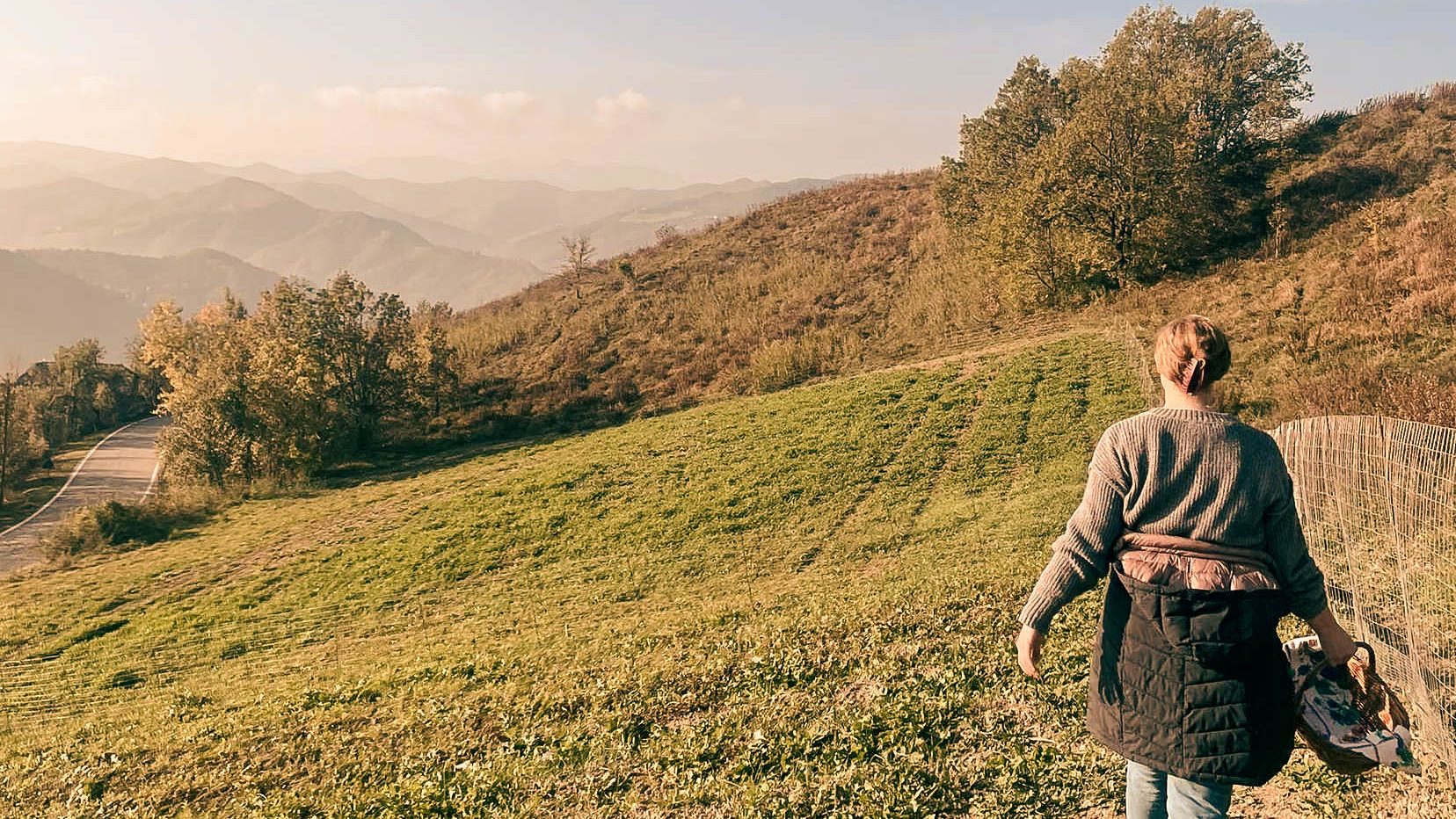
Our schedule was fairly consistent throughout the two weeks we were there. In the mornings, we ate breakfast together at 7am, then at 8am, either walked or drove to the saffron fields, moving slowly up and down the rows looking for saffron buds. Since it was late in the season, there were few buds, if any, to be found.
After checking on the buds, we helped with other parts of the farm. We tilled soil to make planting easier come spring. We weeded (so much weeding). Because we were finishing out the season, when there was nothing left to do in the fields, we helped process saffron and other plants, package them for resale, and even staged a photoshoot for the farm’s social media.
We worked from 8am to 12pm, six days a week, with Sundays as our full day off After finishing work in the fields, we helped our host prepare lunch—usually a soup or pasta made with fresh produce—then relaxed by the fireplace until dinnertime. In the evenings, we sometimes watched movies, baked desserts, walked into town, or, once, did a group yoga session. On weekends, our host took us to nearby towns to explore.
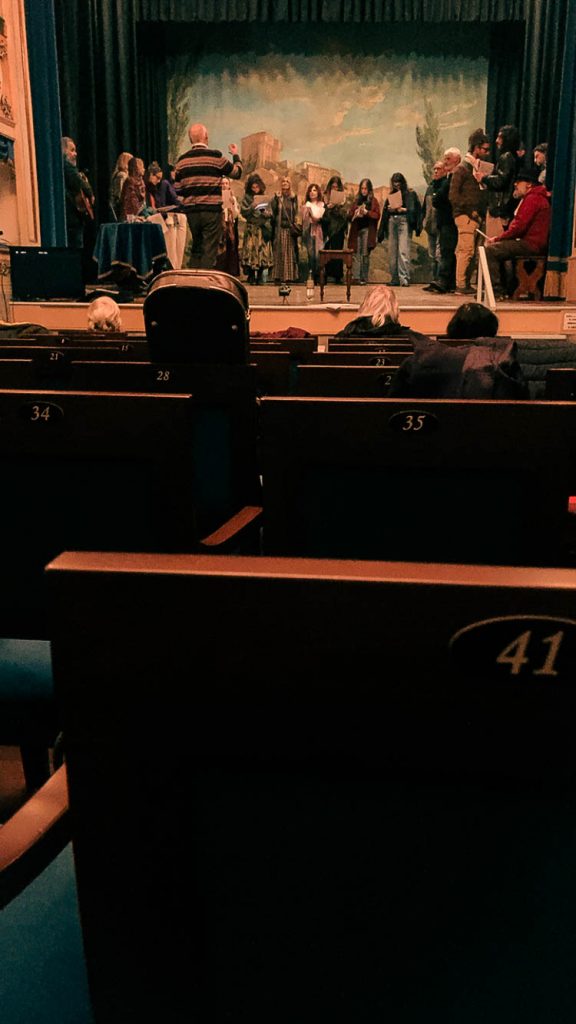
One Saturday, our host told us about a folk dance festival happening in the neighboring town. She had a choir class that day at the town’s local theater, so we went with her in the morning and spent a few hours exploring on our own.
My friend and I spent a few hours wandering around the small village. We bought freshly baked bread and pastries, picked up truffle butter, and stumbled upon a fairytale-themed castle museum. At the end of rehearsal, our host’s choir performed a short concert, and we watched from the audience, cheering everyone on.
Afterwards, we went looking for lunch and instead found some musicians performing in the square. Turns out, they were friends of our host, and all of a sudden, my friend and I were coaxed from the sidelines and onto the dance floor, led by some very kind older Italian gentlemen who, while not speaking a lick of English, were friendly and incredibly patient with my lack of rhythm.
That evening, the folk dance festival took place in a charming theater deeper in town. We found seats in the balcony overlooking the dance floor. At first, I was far too shy to consider joining what turned out to be group dances with very strict choreography.
But everyone was having far too much fun for us not to join in. Our host knew many people there, including the group’s leader, who encouraged us to drink and be merry. Everyone was just so welcoming and sincere, and after a few glasses of mulled wine, my dancing skills (or lack thereof) were no longer my concern.
One of the final dances of the night was a bottle dance. An unopened bottle of wine was placed in the center of the floor, and dance partners took turns circling it and leaping over it, getting as close as possible without knocking it over.
My friend and I watched nervously as seasoned dancers performed near–death-defying tricks over the fragile bottle of red. But my inhibitions had been lowered by wine and a general sense of camaraderie, so when the festival leader gestured for us to take our turn, how could I refuse?
I am not a good dancer, and I’m comfortable with that. And it turns out you don’t need to be a great dancer to spin in circles around a bottle and kick one leg at a time over the top. So my friend and I were dancing, spinning, and laughing, when she managed to clip the top of the bottle with her heel and sent the cork flying into the audience, the rest of the bottle unscathed.
Everyone cheered. I was in awe. We wrapped up our dance shortly after—you could hardly ask for a better ending—and the festival leader stepped forward, poured glasses from the now-opened bottle, and offered a toast to “our friends from America.”
When I think about why I chose to try WWOOFing—or travel at all—I think of that moment: pure joy shared with perfect strangers. My friend and I left the farm a few days later, having finished out the saffron season, and said heartfelt goodbyes to our host, her daughter, and the place where we’d found such peace and learned so much.
Vegetable Farm Near Orte
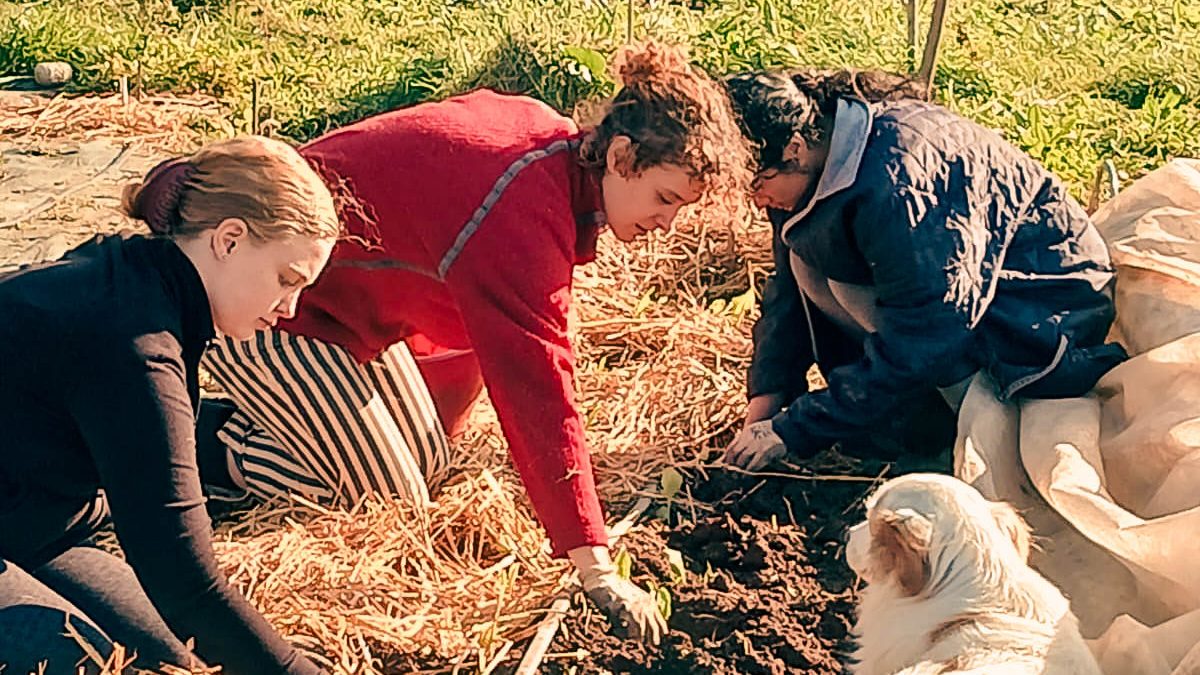
The second farm was a vegetable farm located about an hour outside of Orte. The farm was run by an experienced farmer, with help from her adult son. While I was there, I shared a room with my friend. The other room was occupied by other WWOOFers during our stay: first a girl from Austria and later a boy from Korea. The first week of our stay was spent mostly on the farm. The tasks were different each day, with some harder than others. Every day, we fed the chickens and collected eggs before being assigned other tasks. We helped clear dead fields, cover vegetables to protect them from frost, remove old tubing, plant seeds in the greenhouse, and more.
The work was hard, but rewarding. One day each week, we worked at the local market selling the produce we’d harvested. It was a fun way to meet new people and fulfilled a childhood dream of playing with a cash register.
About a week and a half into our stay, the host asked us to help with a new task: harvesting olives from her olive trees located off-site. We were told we would work from sunup until sundown and bring lunch to eat while we were there so we could work as long as possible before dark.
My friend and I were uneasy about this new arrangement. We were communicating largely through Google Translate, but we gathered that the land hadn’t been touched in years and that we would need to harvest 200 kilos of olives over about five days to send them to a processing facility.
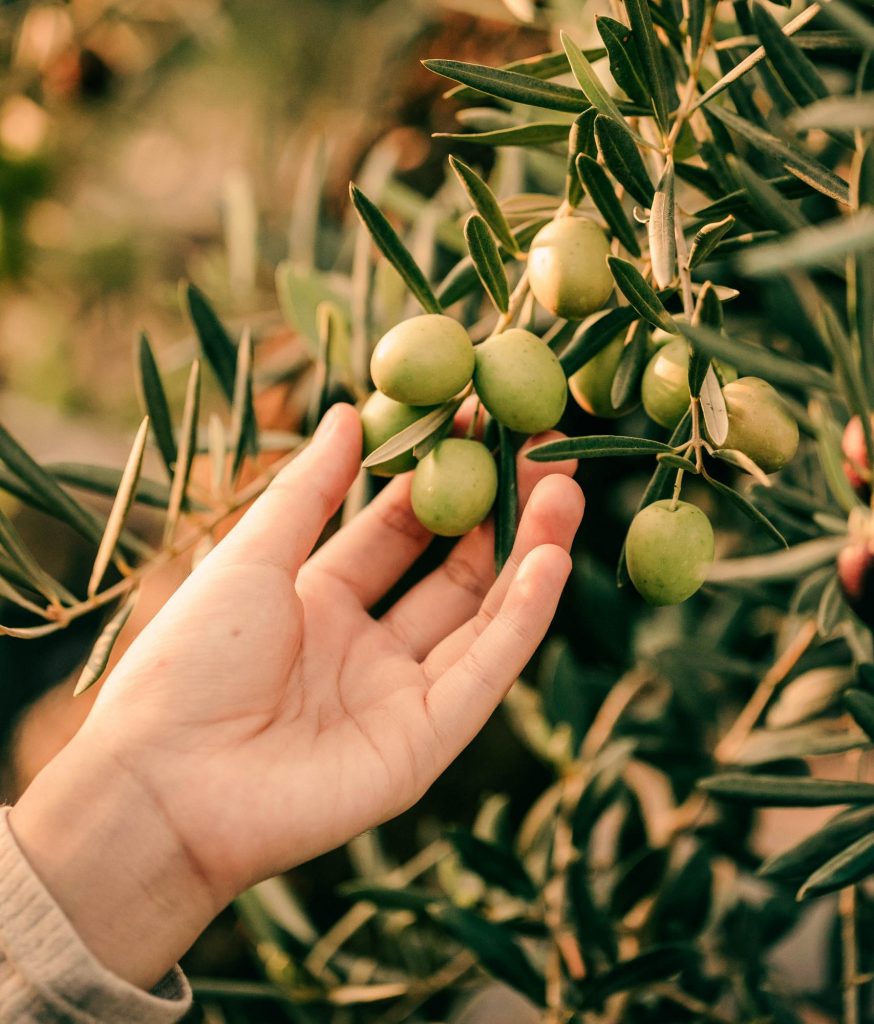
One thing I regret is that I didn’t communicate my hesitation more clearly at the time. I wish I had said, “I feel uncomfortable with this because I lack experience, and this doesn’t seem like a realistic timeframe.” But I didn’t, and instead the three of us hacked through sharp brambles to clear a path to the trees and spent our days hand-picking olives with minimal tools: a hand saw and long rakes used to strip individual branches.
It quickly became clear that our host did not fully understand the workload we were undertaking or how to do it safely. One of us stood on an unsecured ladder using a hand saw to cut large branches so the rest of us could strip olives from the ground. The ladder was not well secured and slipped multiple times. Once, our host cut one of the branches without looking and nearly dropped it on my friend’s head.
These were dangerous situations that should not have been allowed under any circumstances, to say nothing of working until well after dark for multiple days in a row, which felt well outside of the working expectations. Looking back, I wish I had been a better advocate for myself and the other WWOOFers.
At the time, however, I was being fed and housed in her home, and I felt that refusing the work she asked of us would mean taking advantage of her. That isn’t an excuse, but rather a cautionary tale: if I were to WWOOF again, I would ask for a clear work schedule and expectations before arriving so I know what I’m agreeing to and can recognize when something falls outside that purview. That’s why I always recommend asking hosts for clear guidelines before finalizing a stay: it’s for your protection and peace of mind.
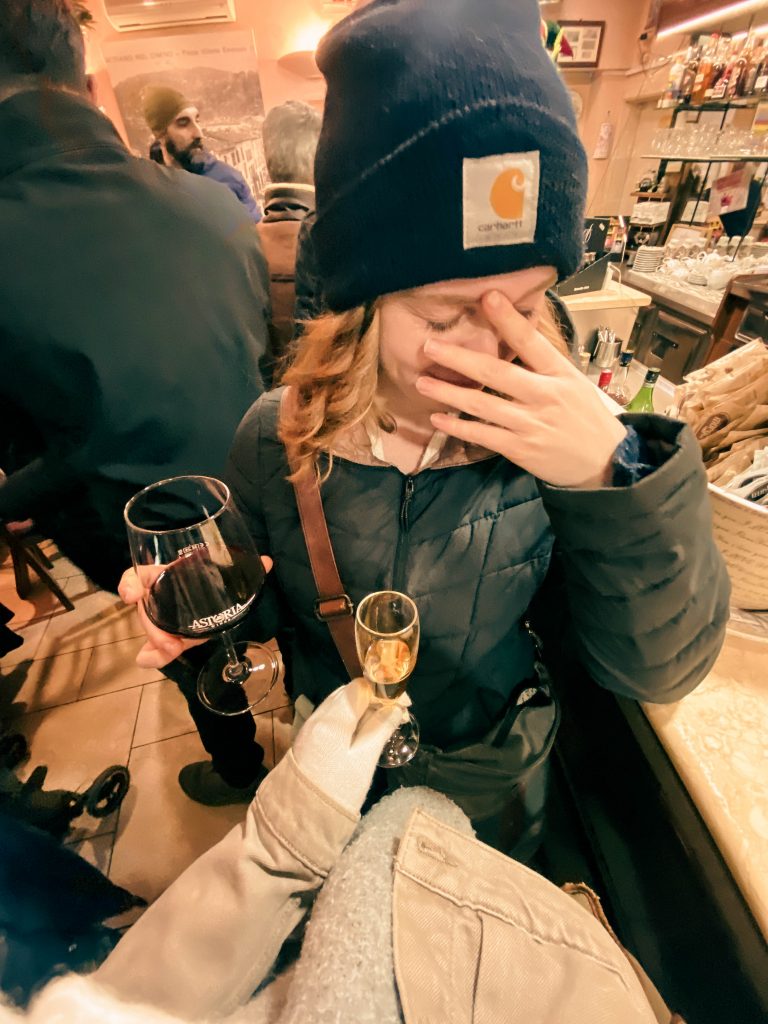
Even though this second stay had stressful moments, I’m still very glad I went. The host was an incredibly kind and interesting woman, and one of the finest cooks I’ve ever had the pleasure of meeting. She taught us how to make gnocchi, carbonara, sausage, and polenta (her husband was Romanian, which later inspired me to visit Bucharest myself). We spent many lovely evenings chatting (via Google Translate) about her past as a political activist and our experiences traveling the world. She even took us to a local holiday concert in the town square, where we gathered in a small wine bar to warm up between sets (pictured here).
So I suppose the lesson I learned from these experiences are that boundaries and expectations are important, and also being open to new ideas and trying new things can lead to incredibly rewarding results. I have no less sappy way to say it. All I know is that I’m grateful I had the chance to work on both farms, and I hope anyone considering WWOOFing hears these experiences and feels empowered to try it themselves.
FAQs
Is WWOOFing free?
You don’t pay hosts, and hosts don’t pay you, but you do need a paid annual WWOOF membership to message hosts and arrange farm stays. Travel to and from the farm is also your responsibility.
You can view membership fees for a list of countries on WWOOF’s FAQs page.
Is WWOOFing considered work or volunteering?
It’s usually classified as volunteering or a cultural exchange, not paid employment.
How long can you WWOOF for?
Stays can range from a few days to several months, depending on the host and your availability.
How many hours a day do WWOOFers usually work?
Most hosts expect about 4–6 hours per day, five days a week, though this varies. Always ask your host beforehand what the work expectations are.
What kind of work will I be doing?
Tasks may include planting, harvesting, weeding, feeding animals, cooking, preserving food, or helping with eco-projects. Specifics should be listed on the farm’s profile.
Do I need farming experience?
No—most hosts welcome beginners and teach you as you go. A willingness to learn and try new things, on the other hand, is a must.
Do I get days off?
Yes. Most hosts offer at least one or two days off per week. Check with your host beforehand to confirm their expectations.
What kind of accommodation is provided?
Options range from private rooms and shared bedrooms to cabins, yurts, or tents, and this varies widely by host. There are also options for folks traveling by RV. These details will be included on the farm’s profile page.
Is food always included?
Usually yes, but the setup differs by host. Some hosts provide all meals, while others provide ingredients for you to cook yourself.
Can hosts accommodate dietary restrictions
Many can, and farm listings generally specify which diets can be accommodated, but it’s still important to communicate any dietary restrictions clearly before committing.
Is WWOOFing safe?
WWOOFing is generally safe, especially when you choose well-reviewed hosts and communicate clearly beforehand. Clear boundaries and expectations also go a long way toward feeling safe while WWOOFing.
What if a host isn’t a good fit?
Remember that you are not obligated to stay. It’s okay to leave if expectations aren’t being met or if you feel unsafe. Your safety is more important than any broken agreement or hard feelings, especially as a volunteer.
Do I need a work visa to WWOOF?
This depends on the country Some countries allow WWOOFing on a tourist visa, while others require a specific visa—always check official immigration rules. I was able to stay in Italy under the Schengen Agreement for 90 days within a 180-day period without needing a visa.
Can I WWOOF internationally?
Absolutely. WWOOF exists in dozens of countries, though memberships are country-specific. If you want to WWOOF in multiple countries, you’ll need to pay a separate membership fee for each country’s platform.
Can couples or friends WWOOF together?
Yes, but you should confirm that the host can accommodate multiple people. The number of WWOOFers a farm can host will be listed on the farm’s profile page. Each person will also need to apply individually on the WWOOF website, meaning everyone must pay the membership fee.
Is there an age limit?
Most WWOOFers are 18+, but some hosts accept families (you can filter your search to find hosts that do).
Is WWOOFing good for solo travelers?
Yes—many WWOOFers travel solo. I originally planned to travel solo before a few friends asked to tag along.
Is WWOOFing suitable for digital nomads?
Sometimes. Reliable Wi-Fi isn’t guaranteed, so check with hosts in advance.
I wouldn’t personally recommend combining digital nomading and WWOOFing unless a host explicitly states they’re digital-nomad friendly. I was interviewing for jobs during my stay at the second farm, and the Wi-Fi was unreliable, which led to stressful pre-interview tech issues. It was also difficult to balance the exhaustion of physical labor with needing to spend the rest of the day on a computer.
How far in advance should I apply?
Popular hosts may book months in advance, especially during peak seasons. I booked my stays about two months in advance, although shorter-notice stays are also available (you can even filter for farms with immediate availability, which is helpful if something comes up last minute).
Final Thoughts On WWOOFing
If you’re looking for a way to travel on a budget and are willing to learn some new skills along the way, WWOOFing can be a great option. It’s a great way to experience a different way of life, meet interesting people, and see more of the world. I highly recommend it if you get the chance.